
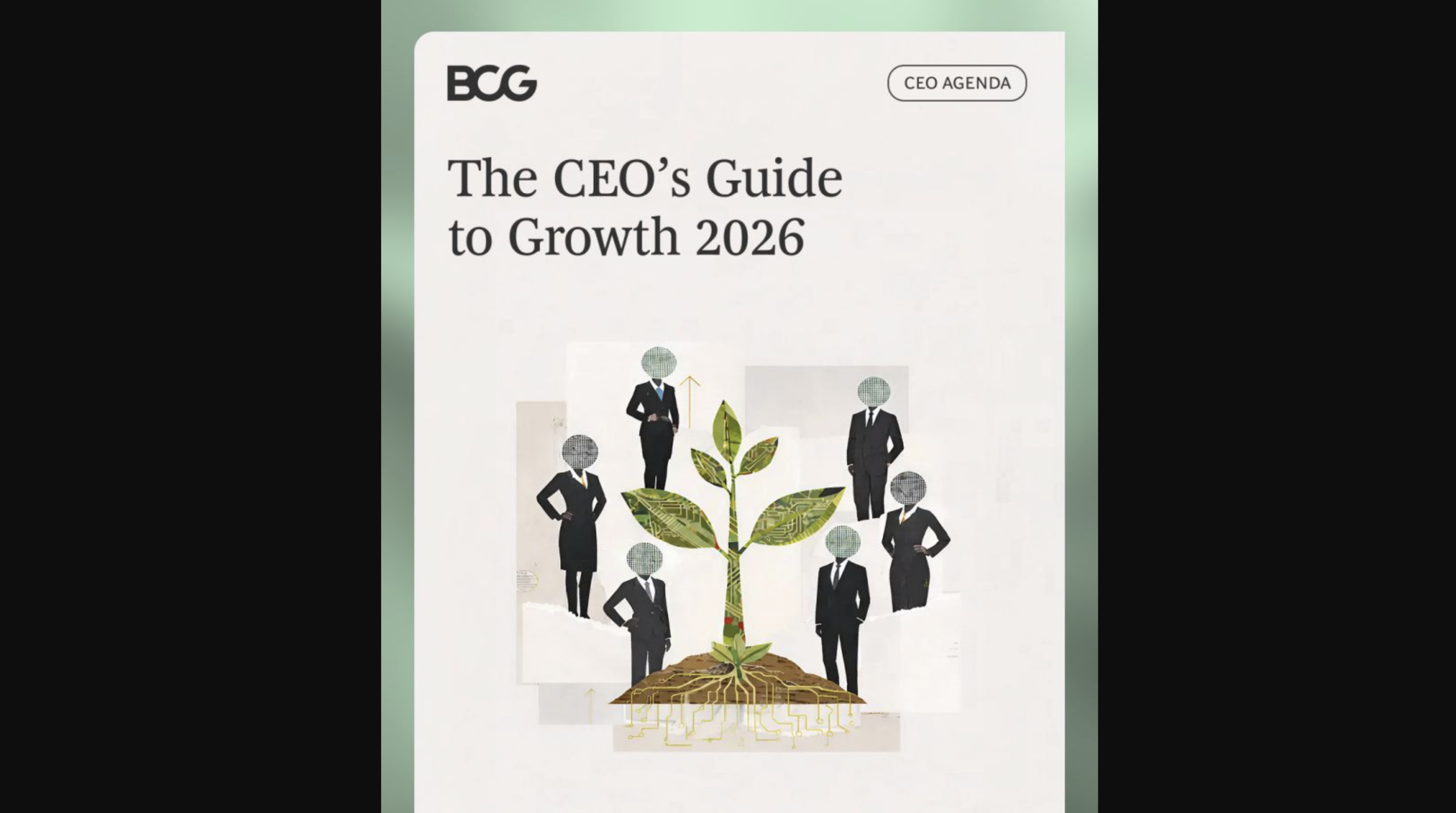
After two years of defensive decision-making, new guidance from Boston Consulting Group shows why CEOs are pivoting back to growth in 2026—and how disciplined ambition is becoming a strategic necessity.
After months of trade disruption, inflation pressure, and constrained capital, CEOs are resetting their agendas. In late 2025, earnings calls across global markets began to signal a shift: references to top-line growth rose sharply, particularly among European companies. This renewed focus on expansion sits at the heart of The CEO’s Guide to Growth in 2026, published by Boston Consulting Group, which responds to a clear pressure facing leaders—how to grow in an environment where volatility is no longer temporary.
The guide argues that growth in 2026 will not come from waiting for stability. Instead, it will be driven by leaders willing to pair bold ambition with disciplined execution. One concrete example is the growing performance gap between companies that have scaled artificial intelligence and those that have not. According to BCG’s research, organizations leading in AI are achieving significantly higher revenue growth, while also accelerating innovation through faster experimentation and lower failure costs. Rather than using AI only to automate tasks, these firms are embedding it into scenario planning, product development, and market prioritization to make faster strategic pivots when conditions shift.
Another focus is the return of dealmaking. After a prolonged slowdown, mergers and acquisitions rebounded in 2025, with increased competition from private equity firms holding substantial undeployed capital. BCG highlights that companies with “always-on” M&A capabilities—those continuously screening targets and preparing for integration—consistently outperform reactive acquirers, particularly in sectors such as data infrastructure, defense, and the energy transition.
Across these themes, several strategic takeaways emerge for association leaders. Growth targets must be explicit and stress-tested, not aspirational slogans. Cost discipline is not the opposite of growth but a prerequisite for funding it. AI should be treated as a core capability, not a side experiment. And strategic readiness—whether for acquisitions or new market entry—must be built before opportunities appear.
Looking ahead, the message for 2026 is clear: resilience protects organizations, but disciplined growth is what allows them to shape their future rather than merely endure it.