
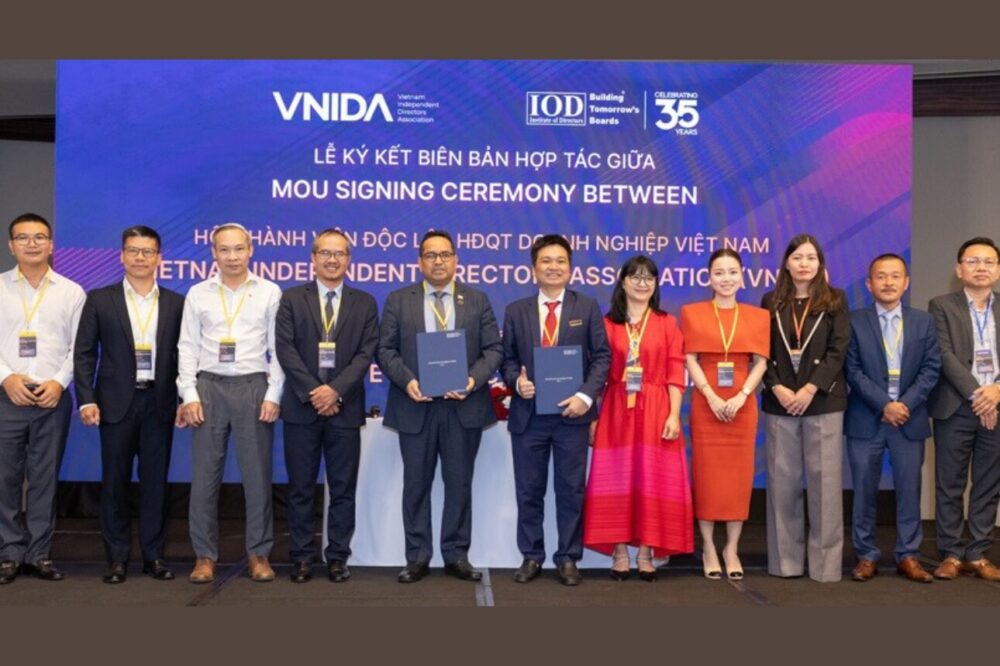
Most cross-border association partnerships begin the same way: a signed MOU, a joint photo, a press statement about strengthening ties. What happens after that is rarely documented, which is exactly where the real work begins.
India’s Institute of Directors (IOD) offers a useful case study because its own site lays out several different instruments of international expansion side by side, rather than just one. In July 2025, IOD signed an MOU with the Vietnam Independent Directors Association (VNIDA), a body established directly under a decision of Vietnam’s Ministry of Home Affairs in 2022. A few months later, in November 2025, it signed a second MOU with the UK’s ACCA (Association of Chartered Certified Accountants), a long-established global accountancy body. Running alongside both are IOD’s annual Global Conventions, which the organisation has held in Dubai, Singapore, London and across Europe for more than 35 years, and its Masterclass for Directors, a certification programme delivered across major cities in both offline and virtual formats.
The VNIDA and ACCA partnerships illustrate the different strategic value that cross-border partners can potentially bring. An emerging national body, established only in 2022 and formally backed by a national government ministry, can provide access to a developing professional ecosystem at an early stage, before the market and its standards are fully formed. An established international organisation like ACCA, with decades of infrastructure and global recognition, can offer institutional reach and brand credibility in markets where IOD’s name is not yet known. IOD has not explicitly stated which strategic logic drove each choice, but the two partnerships together show that different partners serve different purposes, and that the decision of who to partner with is inseparable from what the association is trying to achieve in each market.
IOD’s own MOU Partners page states the purpose of the VNIDA agreement plainly: to “encourage, promote and facilitate the sharing of ideas, information, and networking opportunities among respective members.” That is an intent, not a programme.
Once a partnership is signed, someone inside the organisation has to own the relationship, coordinate any joint activities, determine what success looks like, and eventually decide whether the partnership is producing results or quietly lapsing. None of that is visible in an MOU. And none of it happens without secretariat capacity dedicated to making it happen.
IOD’s Masterclass for Directors is delivered in two formats: a three-day offline session in major metro cities, or a four-day virtual programme for locations where in-person delivery isn’t practical. Every participant, in either format, must submit a Project Study Report within 45 days of completing the programme. That standardised completion requirement is what actually holds the certification together across cities and formats. But the broader governance question it raises is one that any association offering qualifications, CPD, or professional education across borders must answer: what must remain identical across markets, what can be adapted locally, who approves any adaptations, and who audits the quality of delivery. Those are the questions that determine whether international expansion means building a consistent professional standard or allowing it to fragment quietly across geographies.
IOD has sustained international conventions for more than 35 years. The lesson from that is not simply that it has held events in several cities. It is that repeated international activity requires institutional memory. Personnel change, presidents rotate, partners shift, yet the organisation must retain the knowledge to reproduce the programme at consistent quality.
Much of that operational memory ultimately has to reside in the secretariat and the association’s systems, rather than depending on individual board members or office-holders. And every new country or partner on the international map creates operational obligations somewhere inside the association: maintaining relationships, coordinating programmes, protecting brand standards, validating certifications, managing communications, and monitoring whether each MOU is actually producing anything a member would notice.
The real measure of international expansion is therefore not the number of countries appearing on an association’s website, the number of MOUs it has signed or even the number of overseas events it stages. It is whether the organisation has built the systems behind them. Who owns each partnership? What happens after the signing ceremony? Which standards cannot change between markets? Who monitors quality? What resources has the secretariat been given to deliver the board’s international ambitions? And, ultimately, how does the association know whether its international presence is creating value for members?
Signing an MOU may take an afternoon. Building the institutional capability to make that MOU matter can take years.