

Anniversaries are usually designed to celebrate an association’s history. The Singapore Association of Administrative Professionals used its 55th anniversary to do something else as well: create a benefit whose value was immediately different depending on whether someone was a current member, former member or non-member.
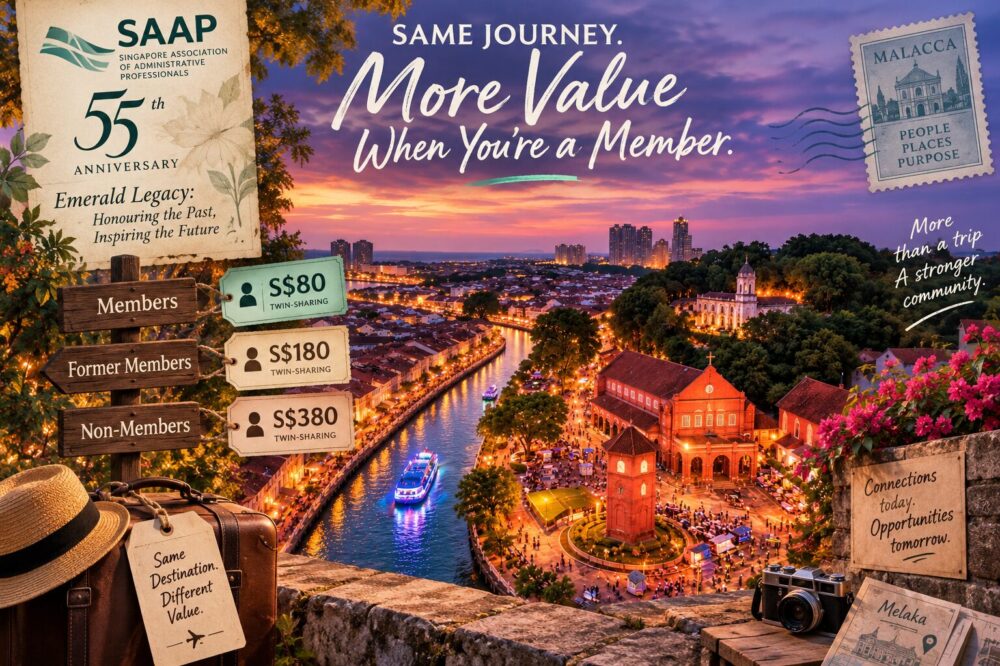
SINGAPORE — For its 55th anniversary in 2026, the Singapore Association of Administrative Professionals (SAAP) adopted the theme “Emerald Legacy: Honouring the Past, Inspiring the Future.” Among its anniversary activities was a two-day trip to Malacca on 11–12 July, including accommodation, meals, activities and the association’s 55th Anniversary Celebration. SAAP described the trip as heavily subsidised.
What makes the activity interesting from an association management perspective, however, is not the destination. It is the pricing.
For twin-sharing participation, a current SAAP member paid S$80, compared with S$180 for a former member and S$380 for a non-member. For single occupancy, the respective prices were S$130, S$230 and S$430. SAAP’s event circular specifically states that fares for members and former members were heavily subsidised by the Association.
When Membership Value Becomes Visible
Associations regularly communicate the benefits of membership through professional development, networking, industry representation and access to resources. But those benefits are not always immediately visible or easily expressed in financial terms.
SAAP’s anniversary activity provides a simple contrast. For the same twin-sharing experience, a current member paid S$300 less than a non-member. Even former members received a substantially lower price than non-members. The pricing structure therefore made the financial value associated with membership status highly visible.
“An anniversary can celebrate the people who built an association while also showing current members what belonging to it means today.”
This does not mean SAAP designed the pricing as a membership retention or win-back strategy; its published material does not make that claim. However, the structure raises a useful question for other associations: can anniversary spending also reinforce the membership proposition itself?
That question becomes particularly relevant because anniversaries require associations to decide where limited resources should go. Some expenditure will naturally support ceremonies, branding and commemorative activities. Another option is to direct part of that investment towards benefits that members can experience personally.
SAAP’s broader history gives that question additional context. The Association describes itself as a volunteer-led organisation and says its development has been shaped by generations of members, committee members and leaders. Its 55th-anniversary theme itself connects the organisation’s past with its future.
Against that background, providing a heavily subsidised anniversary experience to members does more than mark 55 years of the organisation. It allows the people who currently belong to the association to participate in—and receive a tangible benefit from—the milestone.
Who Is the Anniversary Really For?
For association leaders, this creates a useful budgeting question. When an organisation reaches a major milestone, how much of the value created by the celebration reaches the members who helped sustain it?
The answer does not have to be a subsidised trip. An association could direct anniversary resources towards member development programmes, scholarships, special access, networking opportunities, professional resources or other benefits relevant to its community.
The point is not that every anniversary activity must produce a measurable financial return for members. Rather, milestone planning provides an opportunity to consider members not only as the audience for the celebration, but also as its beneficiaries.
Anniversary planning often begins with the organisation: its history, achievements, brand and contribution to the profession. SAAP’s example suggests another starting point: the member.
Associations can ask what part of an anniversary budget will recognise the people who currently sustain the organisation and whether the milestone can make the value of membership more visible.
SAAP’s Malacca trip is therefore the evidence, rather than the larger story. The broader management question is what an association chooses to do with its anniversary resources—and ultimately, who gets to benefit from the milestone.