

New international research suggests global instability is no longer an occasional disruption for meeting organisers but an increasingly important factor in destination selection and event planning.
SWITZERLAND — Nearly three-quarters of organisations surveyed by IAPCO say global conflicts are affecting their ability to plan or host international meetings, highlighting the growing influence of geopolitical risk on the association events sector.
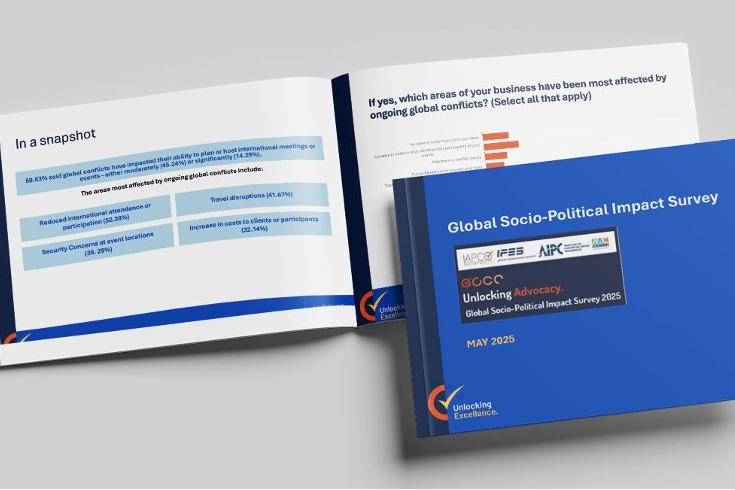
The 2026 Global Socio-Political Impact Survey, led by IAPCO with AIPC, AMC Institute, IFES, ICCA and PCMA, collected responses from 130 organisations. Some 73.84% reported that global conflicts had affected their ability to plan or host international meetings, compared with 53.92% in 2025. 65.38% of respondents reported travel disruption, while 58.46% experienced reduced international attendance or participation. Perhaps more significantly for destinations, 42.31% said they had shifted event locations away from regions perceived as politically unstable. One-third had at some point cancelled, postponed or relocated events, or withdrawn planned participation, because of safety concerns or regional instability.
These figures have practical implications for association boards.
Destination selection has always involved accessibility, affordability, venues and appeal. Risk assessment is now becoming more prominent — encompassing security, aviation disruption, visa policies, insurance and the ability to relocate or redesign an event at short notice.
Government policy is another factor. Almost six in ten respondents said US policies enacted during 2025 and 2026 had affected their ability to plan events for 2026–2028, with funding restrictions and visa and immigration policies identified among the challenges.
For PCOs and associations, contingency planning can consequently no longer sit quietly at the back of an event manual. In an uncertain operating environment, resilience may increasingly become one of the criteria by which both destinations and event partners are evaluated.