

A renewed agreement supports a larger exhibition portfolio in Singapore, creating potential points of engagement for associations in mobility, healthcare, pharmaceuticals and environmental services.
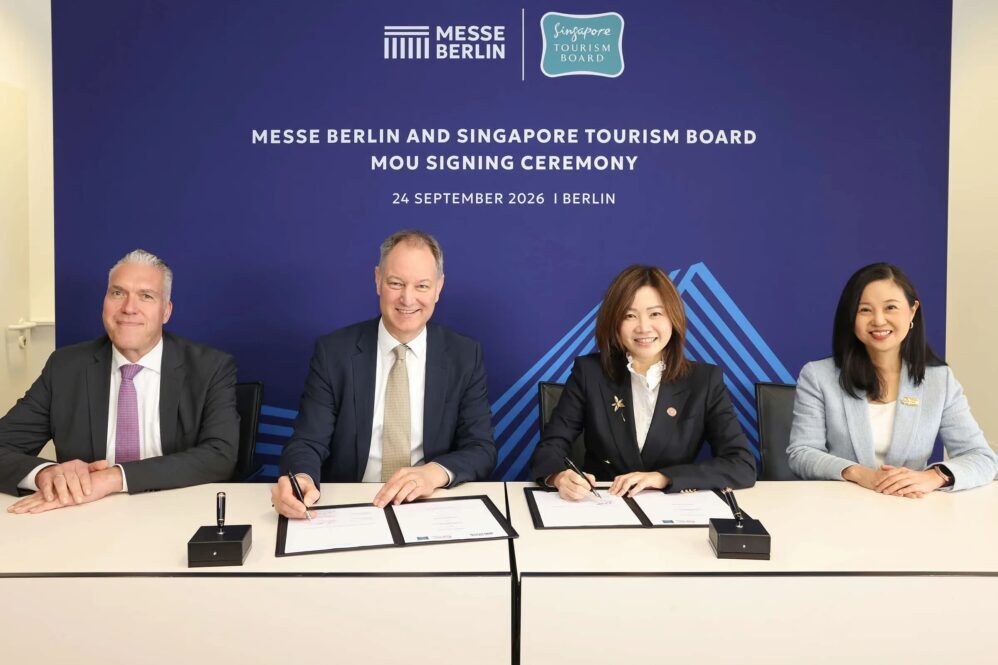
SINGAPORE — The Singapore Tourism Board and Messe Berlin have signed a memorandum of understanding to strengthen the organiser’s presence in Singapore and Asia Pacific, extending a partnership that began with ITB Asia in 2008.
Announced on 25 September, the agreement covers business development, digitalisation and sustainability, talent and manpower development, and experience development. It supports Singapore’s Tourism 2040 ambition to triple receipts from meetings, incentives, conventions and exhibitions.
Messe Berlin’s existing Singapore portfolio comprises ITB Asia, MICE Show Asia, Travel Tech Asia and Smart Health Asia. The announcement identifies three previously announced Asian launches for 2027: InnoTrans Asia, CMS Asia and Smart Pharma Asia. Together, the additions would bring its local portfolio to seven events, spanning travel, tourism, healthcare, pharmaceuticals, mobility and environmental solutions. STB and Messe Berlin also intend to examine opportunities in emerging sectors aligned with Singapore’s economic priorities.
The expansion could create useful meeting points for professional and trade associations whose members operate across these industries. Exhibition platforms can provide access to companies, technical expertise and prospective partners, but associations need to determine where their contribution adds distinct value. A relevant society could explore an independently governed educational session, a standards discussion or a member briefing. Another might convene a specialist working group around a shared industry challenge. These are potential approaches, rather than partnerships announced in the agreement.
The distinction between commercial reach and professional purpose matters. Associations should establish how speakers are selected, how sponsors participate and who retains responsibility for educational content. Clear terms help protect member confidence while allowing constructive collaboration with organisers.
The talent component is also worth examining. An association’s involvement could connect established practitioners with students and emerging professionals, provided the engagement offers practical learning and identifiable responsibilities. Attendance alone does not demonstrate skills development.
Likewise, sustainability collaboration should be assessed through concrete operating measures. Associations could ask prospective partners about procurement, accessibility, waste management and the availability of event data, then select indicators appropriate to their own objectives.
The agreement gives Singapore another basis for building relationships across business events and industry development. For association leaders, the practical next step is to map the expanding portfolio against member needs and identify where a carefully structured partnership could support education, professional exchange or sector growth.