
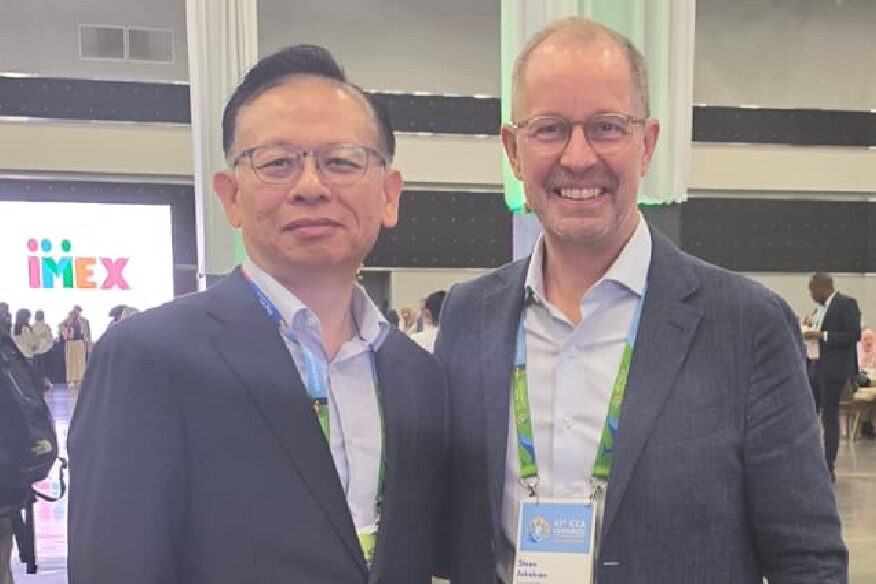
Ooi Peng Ee, Editorial Director of Associations Commons with Steen Jakobsen, CEO of GainingEdge on Day 2 of ICCA Congress 2026 in Panama City.
Steen Jakobsen outlines plans to broaden GainingEdge’s expertise and global reach, while highlighting why cost, venue availability and financial support remain decisive considerations for association congress organisers.
ICCA Congress, Panama City — International business events consultancy GainingEdge is preparing for its next phase of growth, broadening its consulting expertise, and exploring opportunities in new geographical markets.
Speaking to Associations Commons during the ICCA Congress in Panama, Steen Jakobsen, who joined GainingEdge in September 2025 following nearly 25 years in the convention bureau sector, outlined his ambition to grow and scale the consultancy while preserving the foundations established by founder Gary Grimmer.
Jakobsen described the company’s future as an evolution rather than a revolution.
Founded in 2004, GainingEdge has undertaken hundreds of projects in more than 40 countries, developing established methodologies and specialist capabilities in destination strategy and convention centre consultancy.
For Jakobsen, that experience provides a platform from which to introduce new expertise, expand services and respond to changing expectations across the international meetings industry.
Broadening Expertise & Geographical Reach
One priority is bringing together consultants with complementary professional backgrounds, particularly those who understand how international associations make decisions.
The recent appointment of Tom Reiser, with more than 25 years of association-sector experience, reflects this direction.
Jakobsen believes that professionals who have worked within associations offer insights that convention bureau executives may not necessarily possess, particularly regarding organisational priorities, internal decision-making and the selection of future congress destinations.
Such expertise can strengthen GainingEdge’s ability to advise convention bureaux and venues on how to position themselves more effectively for international association business.
Another addition is Ligia Gonzalez, whose experience includes senior roles with Guadalajara Convention and Visitors Bureau, in addition to her role with Expo Guadalajara in Mexico.
Her appointment also reflects GainingEdge’s interest in Latin America, a region where the consultancy has undertaken projects but where Jakobsen sees opportunities for further development.
Having professionals with local knowledge, regional networks and language capabilities could strengthen its ability to serve destinations across the region.
These appointments illustrate a broader strategy of diversifying expertise without abandoning GainingEdge’s core activities.
The consultancy will continue supporting destination marketing organisations and convention bureaux with strategic planning, while maintaining its work with convention and exhibition centres on feasibility studies, space programming and operational development.
Africa’s Growth Potential & the Rwanda Experience
Jakobsen is particularly optimistic about Africa, predicting that the continent could account for some of the strongest growth in the international business events industry over the next 10 to 20 years.
He pointed to the emergence of new convention bureaux and growing government recognition of business events as instruments for economic diversification, knowledge exchange and talent attraction.
Rwanda provides a timely example.
GainingEdge has been working with the Rwanda Convention Bureau on a major strategic consultancy assignment that began approximately six months ago.
The project involves developing a long-term business events strategy, including a practical operational framework intended to strengthen the bureau’s performance and capabilities.
The consultancy has conducted workshops with local industry stakeholders and convention bureau representatives. At the time of the interview, its final strategy document was nearing completion.
Jakobsen described Rwanda as an ambitious destination, with its preparations to host the 2027 ICCA Congress adding significance to its business events development.
The Rwanda assignment also illustrates GainingEdge’s wider ambitions in Africa. Jakobsen sees opportunities to help emerging convention bureaux establish themselves and support existing destinations through strategic consulting.
For destinations across the continent, the challenge extends beyond attracting international congresses to developing the institutional capabilities needed to compete consistently in the global meetings market.
Legacy Matters, But Commercial Realities Still Drive Decisions
Beyond GainingEdge’s own development, Jakobsen’s observations raise an important question for destinations competing for international association congresses: how much weight do associations actually place on legacy, sustainability and long-term impact when choosing where to meet?
Across the business events industry, destinations are increasingly positioning congresses as platforms for knowledge exchange, professional development, community engagement and lasting societal benefits.
These ambitions have helped broaden the conversation beyond traditional measures such as delegate numbers, hotel room nights and visitor expenditure. Yet the practical realities of organising an international congress remain fundamental.
As Jakobsen’s observations suggest, legacy and impact may form part of a destination’s value proposition, but associations must still evaluate whether a congress is financially and operationally viable.
Venue and hotel availability, competitive pricing, destination accessibility and the level of financial support available can ultimately carry greater weight in the destination-selection process.
For associations operating within limited budgets, these considerations are not simply commercial preferences. They can determine whether an event attracts sufficient delegates, achieves its financial objectives and remains sustainable for future editions.
This creates an important distinction between what destinations aspire to deliver through congresses and what associations require before committing to a host city.
A compelling legacy proposition may strengthen a bid, but it cannot necessarily compensate for an unaffordable venue, high accommodation costs or insufficient financial support.
Equally, the emphasis on cost should not diminish the importance of legacy. Rather, it suggests that destinations need to integrate meaningful impact objectives into commercially competitive and operationally credible proposals.
For convention bureaux, the challenge is therefore to understand the association’s priorities first, rather than assuming that a destination’s broader economic or societal ambitions will necessarily determine the outcome.
Aligning Destination Ambitions with Association Priorities
This is where GainingEdge’s expanded association expertise could become particularly relevant.
Combining destination development experience with a deeper understanding of association governance, budgets and decision-making may enable the consultancy to help destinations develop more realistic and competitive bidding strategies.
It also reinforces the importance of treating associations as long-term partners rather than simply prospective customers for convention facilities.
As GainingEdge looks towards 2027 and beyond, its evolving consultancy model reflects a wider industry challenge: helping destinations pursue ambitious long-term outcomes while remaining responsive to the immediate commercial requirements of the organisations they hope to attract.
For associations and destinations alike, the most successful congress partnerships may ultimately be those that deliver both financial viability and meaningful lasting impact.