
GANGNEUNG, South Korea – For technology conferences, the gap between “demonstrated” and “deployed” is where promising innovations often lose momentum. That gap is the central challenge facing the 2026 ITS World Congress, which opens here on 19 October. The question is not whether the event will showcase impressive technology – it will. The real test is whether a congress organised by ITS Asia-Pacific, ERTICO and ITS America, in partnership with host government authorities, can turn five days of demonstrations into pilots, pilots into standards or policy, and a temporary gathering into a lasting industry legacy.
When the 32nd ITS World Congress opens, the most visible signs of progress will be familiar: connected vehicles, smart infrastructure, data platforms and live demonstrations. The more consequential test will begin after the closing ceremony on 23 October. That is when the hosts and the international associations behind the congress will have to show whether the event has produced work that continues in the city and across the industry.
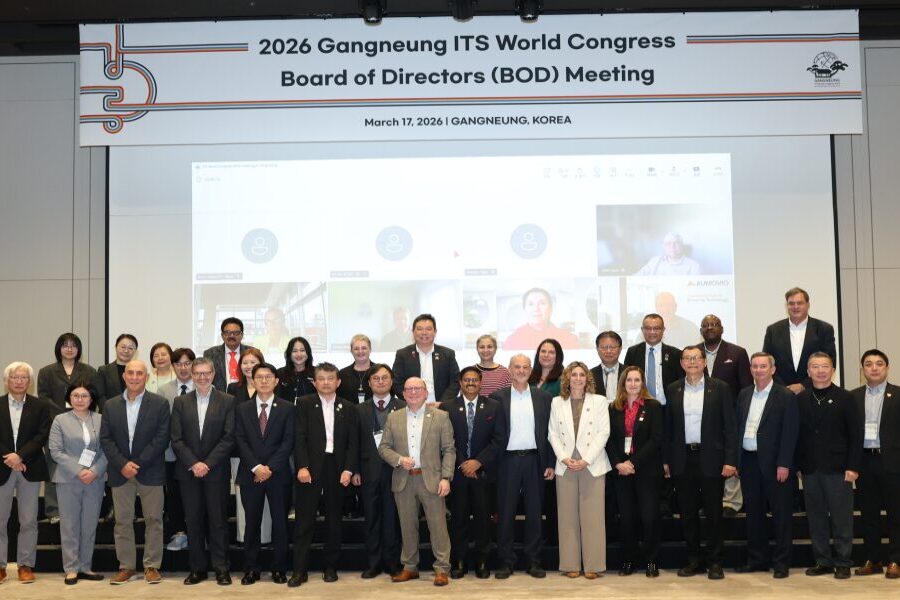
The congress is hosted by South Korea’s Ministry of Land, Infrastructure and Transport and Gangneung City, and organised by the 2026 Gangneung ITS World Congress Organizing Committee and ITS Korea. ITS Asia-Pacific, ERTICO – ITS Europe and ITS America are co-organising the global programme. That structure places public authorities, industry networks and technical communities inside the same event – the combination needed to address interoperability, safety assurance, data governance and regulatory acceptance.
A City, Not a Showroom
Gangneung gives the congress a practical setting. Official planning documents describe a city of about 208,000 people facing mobility pressures common to many mid-sized destinations: an ageing population, residents with limited mobility, sharp seasonal surges in tourism and constrained infrastructure. These are operational problems rather than exhibition themes, and they make the city a useful place to test whether connected transport can work outside a major metropolitan area.
The testbed claim also rests on assets that existed before the congress. The Gangneung Urban Information Center opened in November 2024 as a control hub for traffic, security, environmental and emergency-response data. Congress materials say it is equipped with citywide ITS infrastructure, mobility-control systems and big-data analytics, and will be used for technical tours and demonstrations. The main exhibition hall is a converted speed-skating arena from the 2018 PyeongChang Winter Olympics. Both facilities give the event a physical link to longer-term city operations rather than a temporary display floor.
The congress concept goes further, describing a model in which a traffic management centre connects autonomous shuttles, public transport and shared mobility through a Mobility as a Service platform, supported by demand prediction, dynamic signals and smart parking. Public documents do not establish that every element is already operating at full scale. They do show, however, that the programme is being framed around systems that must function together in a real city.
The Association Layer
That system’s focus clarifies the association role. ERTICO says it is working with ITS Asia-Pacific and ITS America to develop the congress programme. The official call for contributions asks for work on mobility-data platforms and open APIs, public-private data exchange, inter-jurisdictional infrastructure protocols, V2X and urban-air-mobility standardisation, privacy, cyber security, data ethics and governance. None of those issues can be settled by a technology supplier acting alone.
The regional organisations do not need to invent every solution themselves. Their value is in bringing together the institutions that own different parts of the problem and keeping the conversation connected. A city can define the public need and operating conditions. Companies can provide systems and implementation experience. Researchers can test evidence and expose uncertainty. Governments can shape procurement, safety and regulatory routes. Associations can give that work a neutral forum and carry lessons across borders.
The programme provides several entry points: a high-level roundtable, academic and special-interest sessions, technical and research papers, exhibitions, site visits and demonstrations. ERTICO chief executive Joost Vantomme has described the World Congress as a place where partnerships are established and standards are influenced. The statement sets a higher bar than attendance or the number of technologies on display. It implies a route from discussion to decisions that persist.
The Missing Legacy Measure
The current public material is more detailed about what will happen during the congress than what will continue afterward. It identifies venues, programme formats and technical topics, and repeatedly presents Gangneung as a live testbed. It does not yet set out a public legacy scorecard naming post-congress pilots, responsible organisations, continuation dates or the measures by which local and industry outcomes will be judged.
That absence does not mean follow-through work is not being planned. It does mean the congress’s legacy cannot yet be assessed from public evidence. A demonstrator becomes a pilot only when a city or operator agrees to keep testing it under defined conditions. A pilot informs a standard or policy only when results are documented, shared and taken into a recognised working process. A partnership becomes durable only when it has an owner, a timetable and a purpose beyond the meeting.
The Legacy Test: What to Look for After October
For Gangneung, useful evidence after 23 October would include which demonstrations continue on city roads, what infrastructure remains in operational use, how public and private partners will share data, and whether findings enter standards or regulatory discussions through ITS Korea, ITS Asia-Pacific, ERTICO or ITS America. The most persuasive legacy report would connect each result to a local mobility problem – reduced congestion, improved accessibility for elderly residents, better management of tourist traffic surges – rather than to the technology used.
Equally important is who owns each continuation. A demonstration that continues only because the congress organisers arranged temporary funding is not a legacy. One that continues because a city department, a transport operator or a national agency has incorporated it into their planning is. The presence of named owners with post-congress responsibilities is the best early indicator that legacy planning is genuine.
A Congress Designed for Follow-through
The transferable lesson for other technology and professional associations is to design a congress as a chain of responsibility. A real problem should shape the demonstration; an identified partner should own the next-stage pilot; agreed-upon evidence should be collected; and a standards, policy, or procurement forum should be ready to receive the results. Every link requires named participants before delegates arrive, not only a promise of collaboration once the event is under way.
This framework gives associations a practical way to evaluate their own events. Before the congress, they can ask: Which local problems are our demonstrations addressing? Who has committed to continuing each project after the meeting? What evidence will we collect, and where will we send it? After the congress, they can ask: Did the expected continuations happen? If not, why? What changed as a result? These questions move evaluation beyond attendance figures and toward institutional impact.
Gangneung has two advantages: permanent urban infrastructure and an association network that spans three regions. The 2026 ITS World Congress will show whether those assets can be joined into an implementation process. If the organisers can publish what continues after the event, who owns it and what changes as a result, the congress could offer a credible model for how associations turn demonstrations into industry legacy. Without that evidence, the testbed will remain a compelling setting for a five-day showcase rather than proof of lasting change.