
International events are often measured by attendance, exhibition space and the number of business meetings held. Increasingly, however, their longer-term value is judged by what continues after delegates return home.
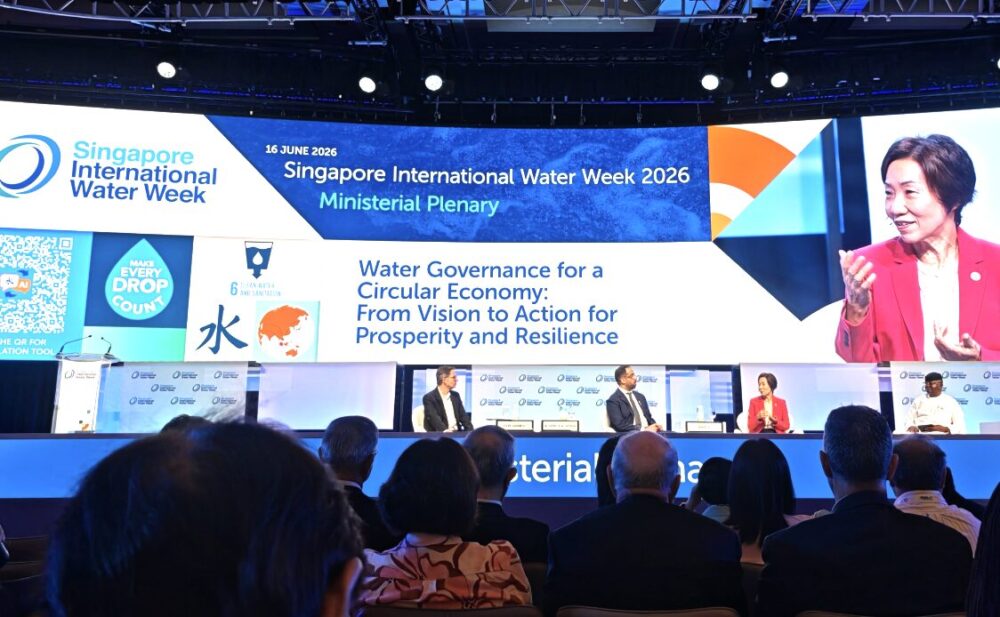
Opening the 11th Singapore International Water Week (SIWW2026), Singapore’s Deputy Prime Minister and Minister for Trade and Industry, Gan Kim Yong, described water as “fundamental to the economy, society, and life itself—and in a world facing climate change and growing uncertainty, a matter of resilience.” That theme ran throughout the four-day event, where governments, cities, utilities, academia and industry came together to explore practical solutions for strengthening water security, climate resilience and sustainable urban development.
Held from 15 to 18 June at the Sands Expo and Convention Centre, SIWW2026 brought together 2,000 delegates, including 800 government, utility and industry leaders, and 21,000 trade visitors from more than 71 countries and regions. Discussions centred on three key themes—Municipal Water Solutions, Industrial Water Solutions, and Coastal and Flood Resilience—reflecting the growing urgency of addressing water scarcity, climate adaptation and sustainable urban growth.
From Discussion to Implementation
One of the event’s most significant outcomes was the announcement of nearly S$100 million in funding under Singapore’s Research, Innovation and Enterprise (RIE) 2030 Urban Solutions and Sustainability domain. The funding will enable PUB, Singapore’s National Water Agency, to advance research into municipal and industrial water solutions, including water treatment, desalination, emerging contaminants and sustainable operations for water-intensive industries such as data centres and semiconductor manufacturing.
In addition, S$14 million was awarded to five projects under the Living Lab pillar of Singapore’s Coastal Protection and Flood Management Research Programme. These projects will test coastal protection measures at selected sites around Singapore, helping translate research into practical climate adaptation solutions.
Rather than ending with recommendations, SIWW2026 linked policy discussions with funding, research capability and opportunities for real-world implementation.
Advancing Water Governance
The event also marked the launch of several frameworks designed to strengthen long-term resilience.
Singapore introduced its Coastal Protection Code of Practice, providing guidance for landowners and industry on meeting coastal protection responsibilities, alongside the Flood-Resilient Developments Guidebook, which offers practical guidance for developments to better manage flood risks.
Internationally, SIWW2026 also hosted the launch of the third addendum to the fourth edition of the World Health Organization’s Guidelines for Drinking-water Quality, updating guidance on areas including water safety planning, microbial risk management and drinking water quality.
Together, these initiatives highlight the growing role of governance alongside engineering and technology in building climate-resilient water systems.
Collaboration Across Sectors
More than 15 memoranda of understanding and strategic partnerships were announced during SIWW2026.
Among them were agreements led by PUB to establish Industrial Water Solutions Innovation Ecosystem Alliances supporting the data centre and wafer fabrication sectors—industries where improving water efficiency is becoming increasingly important for both operational resilience and ESG performance.
Other collaborations extended beyond the water sector. Ramboll, Henning Larsen, the Royal Danish Academy and the University of Canberra announced a partnership exploring the use of wastewater treatment by-products as feedstock for low-carbon, circular building materials, while Netatech, Dassault Systèmes and YellowScan launched a collaboration focused on coastal protection, digital twin technologies and autonomous environmental monitoring.
These partnerships reflect a growing recognition that addressing water challenges requires expertise that extends beyond utilities alone, bringing together engineering, technology, research and urban development.
Innovation with Practical Outcomes
The Water Expo, organised in cooperation with IFAT, was the largest in SIWW’s history, occupying 23,000 square metres across six exhibition halls. The exhibition featured 500 companies, including 56% international exhibitors, alongside 53 product launches, 35 project announcements, and numerous contract and partnership signings.
Rather than serving solely as a showcase for new technologies, the Expo connected solution providers with governments, utilities, industrial users and investors, helping accelerate the adoption of technologies addressing water efficiency, reuse, digitalisation and climate resilience.
Knowledge sharing also remained central to the event. More than 100 sessions covered topics ranging from artificial intelligence and industrial water management to circularity, financing models, nature-based solutions and coastal resilience. Leaders from nearly 60 utilities and around 30 cities exchanged experiences in managing increasingly complex urban water challenges, reinforcing the importance of peer learning alongside technological innovation.
Reflecting on the week’s outcomes, Ryan Yuen, Managing Director of Singapore International Water Week, said the event demonstrated what could be achieved when governments, cities, utilities, researchers and industry worked towards common goals.
“SIWW2026 has shown what is possible when the global water community comes together with urgency, purpose and ambition. The ideas, partnerships and solutions advanced this week reflect the momentum needed to strengthen water security, climate resilience and sustainable urban development.”
SIWW2026 demonstrated how international events can support progress long after the exhibition halls close. Alongside discussions on water security and climate resilience, the event produced new funding commitments, research programmes, policy guidance and partnerships that will continue to develop over the coming years.
With SIWW set to return in 2028, the initiatives announced this year will help shape how cities, utilities and industry approach water resilience, sustainable urban development and climate adaptation in the years ahead.