
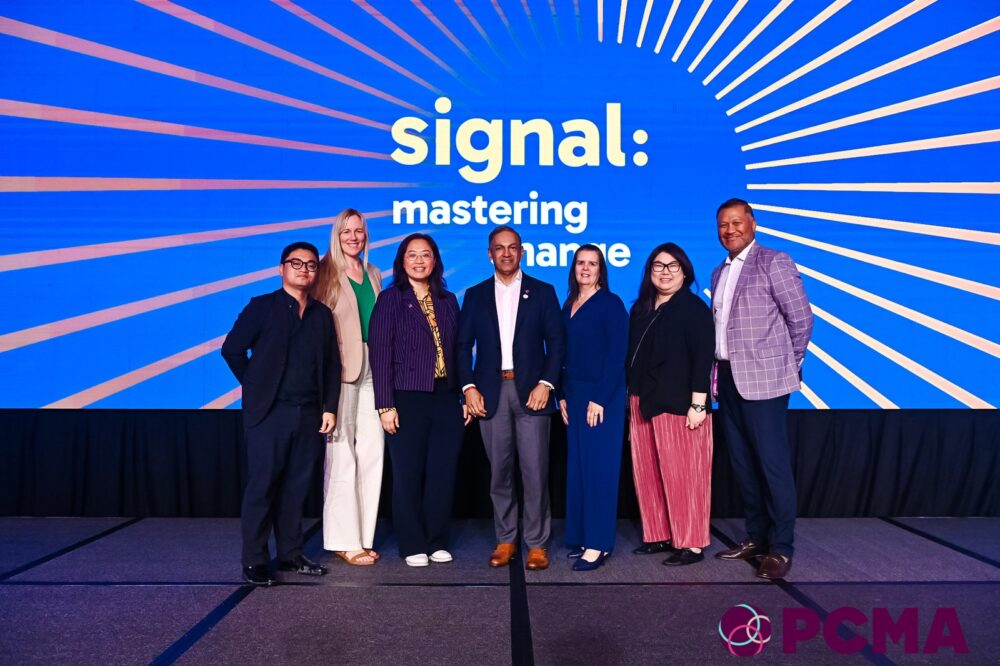
Convening APAC 2026, organised by PCMA, brought together business events professionals, association leaders, and emerging talent in Singapore to examine how the industry is responding to increasing complexity and change. Held at Marina Bay Sands from 12 to 14 April, the conference centred on the theme “SIGNAL: Mastering Change,” focusing on how leaders identify meaningful trends and translate them into strategic decisions.
The event, previously known as The Business of Events (BOE), reflects a broader shift in how business events are positioned. Rather than focusing primarily on operational delivery, discussions examined the role of events as platforms for decision-making, strengthening human connection, and aligning innovation with organisational priorities.
Interpreting Signals in a Complex Environment
Speakers addressed the challenge of distinguishing between noise and meaningful signals in an environment shaped by rapid technological, economic, and social change.
In his session From Signal to Shift, Mark Adams, Chairman of the AI Leadership Council and Co-Founder of Vice Media, focused on how organisations detect and act on signals within networks rather than relying on traditional top-down strategies. He argued that advantage comes from identifying early signs of demand and responding before they become widely visible. He also pointed to a shift from “broadcasting to belonging,” where value is created through communities rather than audiences, and positioned artificial intelligence as a tool that enhances creativity rather than replaces it.
Dr Sandra Peter and Dr Kai Riemer, Co-Directors of Sydney Executive Plus, explored what they described as a “decade of disorientation,” where overlapping disruptions are reshaping how organisations operate. They introduced a set of “messy shifts” and competing priorities that leaders must navigate, alongside the idea of “Blobs” — areas where skills are converging across disciplines. Their session emphasised that preparing for the future is less about following a fixed plan and more about adapting thinking, building new capabilities, and letting go of assumptions that no longer hold.
Leadership and Human-Centred Perspectives
Alongside technology-focused discussions, significant emphasis was placed on leadership and human performance.
Pauline Nguyen, entrepreneur and founder of Red Lantern, framed leadership as an internal discipline grounded in self-awareness, behaviour, and consistency. She emphasised how clarity, presence, and the ability to manage pressure shape decision-making and influence teams, particularly in uncertain environments.
Natalie Dau, endurance athlete and Guinness World Record holder, offered a complementary perspective on performance under pressure, linking physical endurance to professional resilience. Her session highlighted how mindset, discipline, and adaptability support sustained performance in fast-changing conditions.
Together, these sessions pointed to a broader shift: leadership in the business events sector increasingly depends on both analytical capability and human-centred understanding.
From Strategy to Application
The programme also placed emphasis on how ideas translate into action, beginning with the Day Zero Challenge on 12 April. Structured as a collaborative exercise, the session brought participants together to test future scenarios for the business events industry. Discussions focused on long-term strategy, adaptability, and the extent to which current approaches can respond to rapid shifts, including the impact of artificial intelligence.
This focus on application continued through PCMA Labs, which took place on the last day of the programme. These smaller, focused sessions explored topics such as AI adoption, experience design, and leadership development, encouraging participants to consider how earlier discussions could be implemented within their own organisations.
A multi-generational learning approach was also evident, with senior professionals and emerging talent engaging in shared sessions. This format supported knowledge exchange across experience levels and highlighted the importance of developing future leaders within the industry.
Industry Priorities and Emerging Directions
Across the programme, several areas of focus became clear.
Artificial intelligence and advanced technologies were frequently discussed in relation to decision-making, personalisation, and operational planning. At the same time, speakers noted that technology alone is not enough. While AI can process large amounts of information quickly, it cannot fully account for context, judgement, or human relationships, which remain important in complex situations.
Workforce transformation was another key theme. As roles in the industry continue to evolve, there
is growing demand for professionals who can combine technical understanding with strategic thinking. This includes being able to work with data, adapt to change, and make decisions across different functions, rather than relying on a single area of expertise.
Sustainability was approached from a long-term perspective. Discussions focused on how events contribute to broader organisational and societal outcomes, rather than only meeting short-term targets or requirements.
Regional growth within Asia Pacific also remained central. The region’s diversity and ongoing development were highlighted as both opportunities and challenges, shaping how organisations plan and operate across different markets.
Reframing the Role of Business Events
Taken together, the discussions at Convening APAC 2026 point to a continued shift in how business events are understood and evaluated.
Rather than being viewed primarily as logistical or marketing activities, events are increasingly positioned as strategic tools that support leadership alignment, knowledge exchange, and organisational development. The emphasis on interpreting signals and acting with clarity reflects a broader recognition that uncertainty is now a constant condition.
In this context, the role of business events extends beyond convening audiences to enabling better decisions and stronger connections in complex environments.