
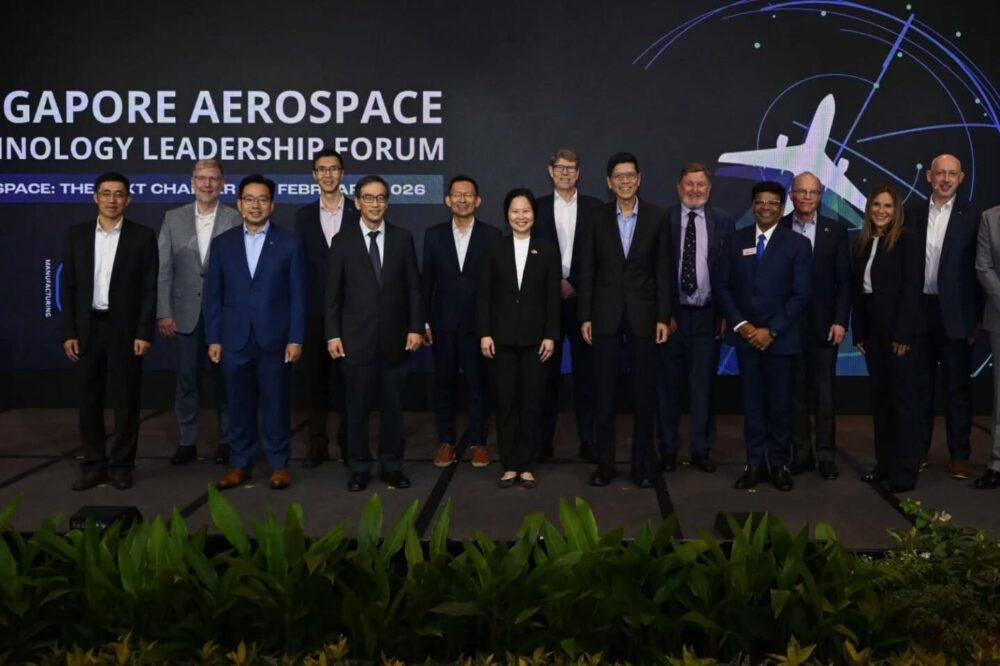
The Singapore Aerospace Technology Leadership Forum (SATLF) 2026 marked the ninth edition of the aerospace industry forum held in Singapore on 2 February 2026. Co-organised by A*STAR’s Singapore Aerospace Programme and the Association of Aerospace Industries (Singapore), the event brought together representatives from industry, government, and research institutions. Minister of State for the Ministry of Trade and Industry and Ministry of Foreign Affairs, Siow Huang Gan, attended the forum and shared perspectives on industry development.
Held under the theme “Aerospace: The Next Chapter,” the programme focused on developments in intelligent maintenance, repair, and overhaul (MRO), alongside sustainability considerations across the aviation sector. Discussions explored the use of artificial intelligence, automation, and data-driven systems in maintenance operations, while other sessions examined the use of greener materials, production processes, and circular design approaches. The programme included keynote speeches, panel discussions, and networking sessions.
Speakers also discussed Singapore’s position within the global aerospace sector. Minister Gan noted the role of public–private partnerships and continued investment in research and development in supporting industry development. Participants highlighted ongoing growth in global MRO demand, alongside the need for a skilled workforce to support future industry requirements.
Key Themes from the Forum
Technology and Operational Development
Discussions examined how technological innovation may shape future maintenance practices. Sessions on intelligent MRO explored the application of artificial intelligence and automation to support maintenance planning and operational efficiency. Data-driven systems and predictive approaches were also discussed in relation to improving scheduling and extending component lifespan.
Sustainability in Aviation
Sustainability was addressed through sessions focused on emissions reduction and resource efficiency. Panel discussions explored pathways towards net-zero carbon emissions by 2050, including the use of sustainable aviation fuel (SAF), alternative propulsion systems, and electrification technologies. Industry participants, including Honeywell, presented developments in avionics and maintenance systems aimed at improving fuel efficiency.
Workforce and Capability Development
Workforce transformation emerged as a recurring topic across sessions. Speakers discussed how advances in automation and data-driven systems are influencing skill requirements within the aerospace sector. Participants highlighted the need for capabilities in areas such as data analytics, predictive diagnostics, and system integration, alongside the importance of training and education alignment.
Industry Coordination and Governance
Sessions also addressed coordination between public and private stakeholders. Topics included regulatory standards, aviation safety, and approaches to responsible technological adoption. Minister Gan noted the role of public–private collaboration and long-term research investment in supporting sector development. Participants also discussed the need for coordinated planning in response to increasing global MRO demand and evolving talent requirements.