
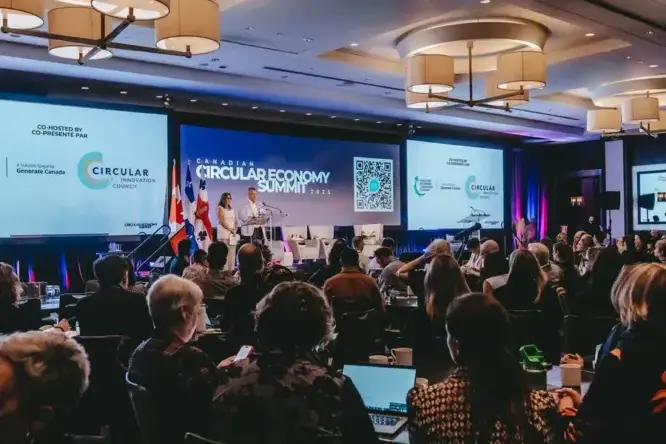
The Canadian Circular Economy Summit 2025 features in Business Events Montréal’s ImpactAIQ case studies. Image source: Tourisme Montréal.
An AI platform introduced around IMEX America offers associations a way to connect congress ambitions with evidence of change, raising practical questions about how impact is planned, measured and communicated.
IMEX AMERICA, Las Vegas, USA — A new event impact platform being introduced at IMEX America is addressing a question familiar to association boards: what does a congress achieve after delegates leave? ImpactAIQ, co-led by #MEET4IMPACT and Gevme, is designed to help event and destination leaders plan intended outcomes and assemble evidence of the value created.
IMEX identified the platform among its show announcements and confirmed that IMEX America would serve as an innovation pilot. The launch was scheduled for 13 October. For associations seeking to explain the contribution of their flagship meetings, the proposition deserves attention, particularly where annual reporting has concentrated on delegate numbers, revenue and satisfaction.
Bringing Scattered Evidence Together
ImpactAIQ’s developers describe a recurring problem: useful evidence sits across surveys, interviews, operational records and partner feedback, making it difficult to produce a coherent account of an event’s contribution. The platform aims to connect impact planning with indicators, evidence and reporting.
Business Events Montréal, an early innovation partner, describes a collaborative evaluation process involving organisers, the destination and methodological support from #MEET4IMPACT. Its account explains that AI processes qualitative and quantitative material and helps generate report text from the resulting analysis. This places the technology within an evaluation process that still requires people to determine the questions and interpret the evidence.
Learning from Montréal
The destination’s published case studies include the Canadian Circular Economy Summit 2025 and the National Conference on Ending Homelessness 2025. Both brought together communities whose interests extended beyond tourism expenditure. Montréal’s account describes using structured impact dimensions and engagement with stakeholder groups to make contributions more visible.
The examples are useful because many association congresses operate in similar settings. Professional education may be the immediate purpose, while the wider ambition includes improved practice, stronger research relationships or better public understanding. A reporting framework can help distinguish those ambitions and identify what evidence would support each one.
Starting with the Association Mission
For an association board, the first decision should concern the change its congress is intended to support. A medical society might seek wider adoption of a clinical practice. An industry association might want members to understand a new standard. These are illustrative goals, and each calls for different evidence and follow-up.
Choosing the goal before designing the programme makes measurement more useful. Organisers can then decide which stakeholders should contribute, what information can reasonably be collected and who will remain responsible once the meeting ends. The destination bureau may help connect the congress with relevant local institutions, but the association needs to retain ownership of its professional objectives.
A manageable first exercise could focus on one congress objective rather than attempt to measure every possible benefit. Agreeing a small set of indicators with the relevant partners would help the association test its approach, identify missing information and determine whether the resulting report actually supports a decision about its next event or investment.
Keeping Claims Proportionate
AI can assist with organising material and drafting an account, but association leaders should examine the basis of any claim about lasting change. A positive delegate survey records an immediate response. A subsequent collaboration or documented change in practice provides a different kind of evidence.
A useful report should make those distinctions visible, acknowledge gaps and avoid attributing every later development to the congress. Leaders evaluating a platform should also ask how evidence can be traced, how sensitive information is handled and how findings are reviewed before publication. Clear answers would help boards assess whether the reporting process supports their responsibilities to members and partners.
A More Useful Conversation with Partners
The opportunity for associations lies in building a shared account of value with host destinations, sponsors and members. Clear objectives and credible evidence could make partnership discussions more specific and help boards decide which congress activities warrant continued investment.
ImpactAIQ offers a timely prompt to review that process. Its usefulness will depend on the quality of the evidence and the judgement applied to it. For associations, the starting point remains a clear statement of what their congress should change and for whom.