
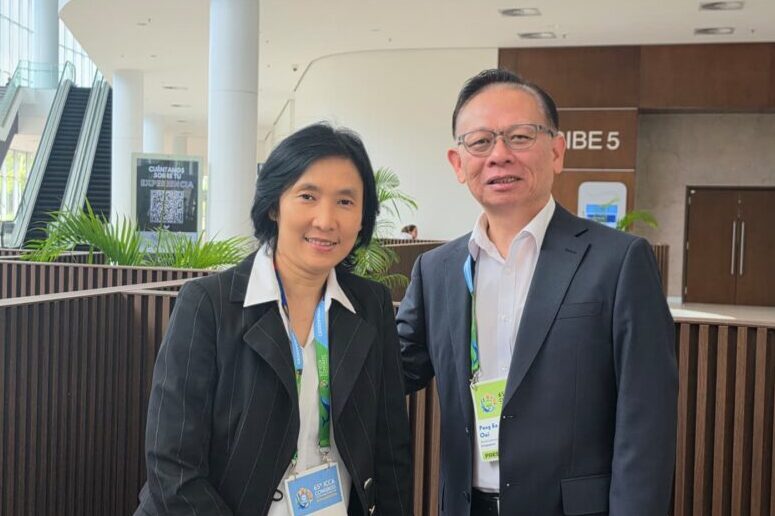
Ooi Peng Ee, Editorial Director of Associations Commons (Right) with Jittanun Techasarin, Director of TCEB’s Conventions Department (Left) on opening day at ICCA Congress 2026.
Thailand Convention and Exhibition Bureau (TCEB) is taking a more strategic, association-centred approach to attracting international congresses, focusing on leadership development, tailored support and strengthening the country’s professional congress organising capabilities.
ICCA Congress, Panama City – Thailand Convention and Exhibition Bureau (TCEB) is sharpening its strategy for international association meetings, placing greater emphasis on empowering local associations, developing professional expertise and aligning congress attraction with the country’s longer-term development priorities.
Speaking to Associations Commons during the ICCA Congress in Panama, Jittanun Techasarin, Director of TCEB’s Conventions Department, explained that attracting international congresses requires more than destination promotion and financial incentives. It demands a deeper understanding of associations’ motivations, capabilities and aspirations.
“For medical doctors, most come together to help people,” she explained, emphasising that knowledge sharing, professional development and the exchange of best practices are fundamental reasons associations organise congresses.
Medical congresses account for more than 70% of the association meetings she described in Thailand, alongside gatherings in science, technology and other disciplines.
Tailored Support for Associations at Different Stages
According to Jittanun, Thai associations broadly fall into three categories: established organisations experienced in hosting international congresses; associations whose members attend international meetings but have yet to host one; and organisations whose experience remains largely domestic.
The second category, she estimated, represents approximately half of the associations currently receiving TCEB’s support.
Rather than introducing standardised programmes, TCEB is adopting a more personalised engagement strategy, identifying association leaders and understanding their specific needs before determining appropriate assistance.
“We listen first,” she emphasised, explaining that professional organisers are most effective when associations, many of which are used to managing their own meetings, see the value for themselves.
TCEB therefore seeks to build trust, nurture relationships and introduce professional support when associations recognise its value.
The bureau also identifies potential international congresses proactively, while supporting opportunities initiated by associations themselves.
Congresses as Instruments of National Development
Another focus is the closer alignment of congress attraction with Thailand’s national development priorities.
Jittanun highlighted areas including AI and intelligence technology; medical, health and wellness, and the longevity economy; food and agri-food innovation; and future mobility and advanced manufacturing, including green industries and the BCG (Bio-Circular-Green) economy.
Some, such as medical and wellness, are fields where Thailand is already strong. In others, she noted, Thailand’s expertise is still growing.
In both cases, attracting relevant international congresses can help develop domestic expertise, expand professional networks and accelerate the growth of emerging industries.
The strategy effectively positions international association meetings as catalysts for knowledge development rather than simply contributors to visitor arrivals and economic impact.
Building Specialist Congress Expertise
Jittanun also highlighted a priority for the industry: as more Thai associations host international meetings, demand for specialist congress expertise is growing.
Association congresses demand longer planning horizons, specialised knowledge and sustained stakeholder engagement.
TCEB is consequently working with industry partners, including the Thailand Incentive and Convention Association (TICA), to strengthen professional capabilities.
Significantly, the bureau is increasingly receptive to international PCOs establishing a presence in Thailand, recognising the potential for greater competition, local employment and knowledge exchange.
For TCEB, strengthening Thailand’s convention sector ultimately requires developing both sides of the equation: associations capable of attracting and hosting international congresses, and professional partners equipped to support their ambitions.
The underlying objective is clear: building a more capable, internationally connected association ecosystem that can contribute meaningfully to Thailand’s long-term development.
At the ICCA Congress, Thailand contributed to discussions on sustainable gastronomy for the third consecutive year, building on the Bangkok Protocol on Sustainable Gastronomy, an initiative launched by ICCA in partnership with TCEB at the 2023 Congress in Bangkok. This year, Nantaporn Thirapongphaiboon of The Global FoodBanking Network highlighted how congress organisers can collaborate with local food banks to redistribute surplus food and reduce food waste.