

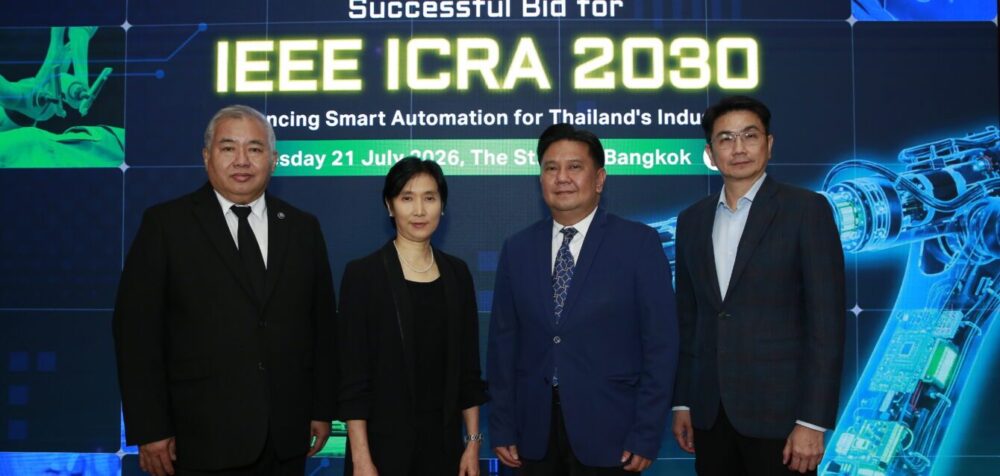
Thailand has won the bid to host the IEEE International Conference on Robotics and Automation (IEEE ICRA) 2030, marking the first time the world’s leading conference on robotics, artificial intelligence (AI), and automation will be held in the country.
Scheduled for 13–17 June 2030 at the Queen Sirikit National Convention Center (QSNCC) in Bangkok, the conference is expected to attract around 10,000 delegates, including approximately 8,000 international participants. The successful bid was jointly led by the Thailand Convention and Exhibition Bureau (TCEB), the Faculty of Engineering at Mahidol University, the IEEE Robotics and Automation Society (RAS) Thailand Chapter, and the IEEE Thailand Section.
While the event is projected to generate more than THB 1.06 billion in direct economic circulation, organisers have placed greater emphasis on its long-term strategic value. Rather than viewing IEEE ICRA 2030 solely as an international convention, stakeholders described it as a platform to strengthen Thailand’s capabilities in robotics, AI, and advanced manufacturing while supporting the country’s ambition to become a regional innovation hub.
According to TCEB, the conference aligns with Thailand’s strategy of attracting business events that contribute to industry development, technology transfer, and investment, extending their impact beyond tourism and delegate spending. The event is expected to bring together researchers, technology developers, investors, manufacturers, and policymakers, creating opportunities for collaboration across academia, industry, and government.
Associate Professor Dr. Jackrit Suthakorn of Mahidol University’s Faculty of Engineering noted that IEEE ICRA serves as a meeting point for research, technology commercialisation, and business partnerships. In addition to showcasing advances in robotics and automation, the conference provides opportunities for startups, technology companies, and research institutions to engage with global industry leaders and potential investors.
Industry representatives also highlighted the conference’s potential to accelerate the adoption of robotics and AI across sectors including automotive, healthcare, food manufacturing, and electronics, while supporting workforce development through reskilling and upskilling initiatives.
The successful bid reflects a broader trend in destination strategy, where international conventions are increasingly viewed as catalysts for innovation, investment, and long-term economic development. Rather than measuring success by attendance alone, destinations are placing greater emphasis on the knowledge exchange, partnerships, and industry growth that major business events can generate.