

ACI Asia-Pacific & Middle East’s Green Airports Recognition has spent a decade drawing climate-adaptation practice out of its members. The harder question is whether that practice is being turned into shared knowledge — or filed away with the trophy photos.
BANGKOK, Thailand — On a stage in Bangkok in May, 12 airports from across Asia-Pacific and the Middle East collected Platinum, Gold and Silver awards in the 10th edition of the Green Airports Recognition (GAR), the flagship climate programme of Airports Council International Asia-Pacific & Middle East (ACI APAC & MID). The 2026 theme was “Climate Change Adaptation”, and the 33 submissions it attracted documented operational responses to flooding, extreme weather, storm surges, heat and water scarcity, raised electrical infrastructure, heat-resistant runway materials, redesigned drainage.
None of that is surprising for an association-management audience; awards recognise excellence, and that is their job. What matters to ACI, and to every association that runs an awards programme, is what happens next. Does the knowledge inside those 33 entries become a transferable asset for the rest of the membership, or does it expire when the ceremony does?
Adaptation is moving from sustainability ambition to operational requirement: airports now plan for the storm that has not happened yet, not just the emissions they can count. The judging panel for GAR 2026, which included Stefano Baronci, ACI APAC & MID’s director general, alongside independent experts from Manchester Metropolitan University, GreenAir Online, ACI World and an environmental consultancy, was effectively reviewing a sector’s survival engineering.
Two Projects, Two Transfer Questions
Consider the two Platinum winners at opposite ends of the scale spectrum.
Hong Kong International Airport won Platinum in the over-40-million-passengers category for its “HKIA Flood Resilience Studies”; advanced climate modelling aligned with IPCC scenarios that tested the airport’s exposure from seawall overtopping to drainage performance. “As Hong Kong faces heavier rain and typhoons, this award affirms AAHK’s strong commitment to climate resilience at HKIA,” said Julian Lee, Executive Director, Finance of the Airport Authority Hong Kong. “The project findings further enhanced our climate risk management.”
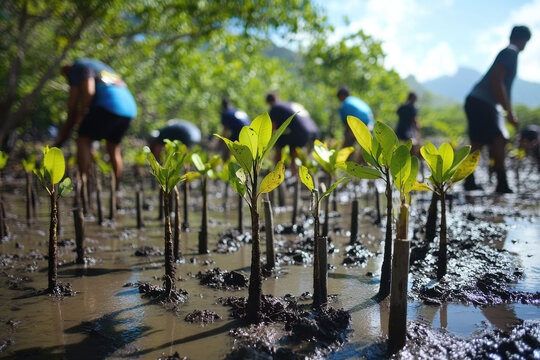
At the other end of the scale, Fiji’s Nadi International Airport took Platinum among airports handling under five million passengers for the Wailoaloa Mangrove Restoration Project: more than 8,300 seedlings planted to shield the airport’s coastal boundary from erosion and storm surge, with community engagement built into the work. Mesake Nawari accepted the award on behalf of Fiji Airports. No modelling software, no major capital programme; a nature-based defence that a neighbouring island airport could begin replicating within a season.
The contrast separates two different kinds of knowledge. HKIA’s infrastructure is not cheaply transferable; its method, scenario-based, IPCC-aligned risk assessment, is. Nadi’s mangrove project is the reverse: the technique is straightforward, but its real lessons live in project management, planting survival rates and community relationships, none of which fit in a two-page award entry. In between sit the engineered-and-nature hybrids: Auckland Airport’s Northern Airfield Climate Resilience Project paired major stormwater upgrades with New Zealand’s first coupled wetland biofilter, treating runoff from more than 100 hectares of airfield; Jaipur’s “Cool Terminal” ecosystem cut HVAC energy use by roughly 35% and surface temperatures by 6–10°C in a semi-arid city that is now a heat-wave hotspot.
The 21 Submissions Nobody Reads
Here is the question the announcement does not answer: of the 33 submissions, only 12 won. What happens to the other 21?
Some of the most useful industry knowledge may sit exactly there. A desert airport’s adaptation project that lost to a better-packaged entry still holds hard-won data on heat-resistant materials; a coastal airport’s stormwater redesign that scored Silver one year may be the template a peer needs now. Judges pick winners on merit, not on transferability, runners-up are not worthless, they are just undocumented.
On the record, ACI documents the winners: it produces a publication covering the recognised projects and acknowledging all participating airports, and it has said winning projects are intended to become best-practice models across its network, informing future benchmarking cycles. Its data pipeline already exists; the 2025 Environmental Survey serves as the entry requirement for GAR 2026 and 2027, meaning submissions ride on standardised data that could, in principle, be indexed, anonymised and searched.
What is not on the record is whether the full corpus of submissions is captured, organised and made accessible to non-winning members, or whether the 21 entries that missed the podium are stored as unread PDFs and forgotten by the next cycle.
“Acknowledgement is not the same as sharing. That is the difference between an awards programme and a knowledge system.”
“Acknowledgement is not the same as sharing. That is the difference between an awards programme and a knowledge system.”
The Asset Associations Are Already Sitting On
GAR is a test case for a broader question every association secretariat should ask itself. Awards entries, conference papers, committee work, surveys and member case studies are, collectively, an institutional knowledge base — arguably the most distinctive asset an association owns, because no single member or commercial supplier possesses it. Most associations still treat these materials as one-off outputs: the ceremony ends, the PDF is filed, the knowledge leaks away.
The fix is not complicated in principle. Treat every submission as a data point rather than a competition entry: capture it in structured form at the point of receipt, tag it by risk type and solution category, publish the corpus to members with clear terms, and track whether recognised practices are adopted elsewhere. Replication is the only metric that proves knowledge transferred.
Four indicators would tell an outsider whether transfer is real:
- Replication (has any airport adopted raised electrical infrastructure or a coupled wetland biofilter since the award?),
- Cost (do the published case studies include capital and operating figures?),
- Resilience (what happened at the next extreme weather event?), and
- Operational disruption (what did implementation cost in closures or passenger disruption? ).
The first and last need interviews with an airport operator and an engineering supplier; the middle two need better documentation.
A recognition programme produces evidence; a knowledge system produces change. ACI has spent 10 years proving it can persuade members to submit their best thinking. The harder achievement, turning 33 entries, including the 21 that didn’t win, into practices other airports can find, afford and adopt, will determine whether the award was the end of a story or the beginning of one.