

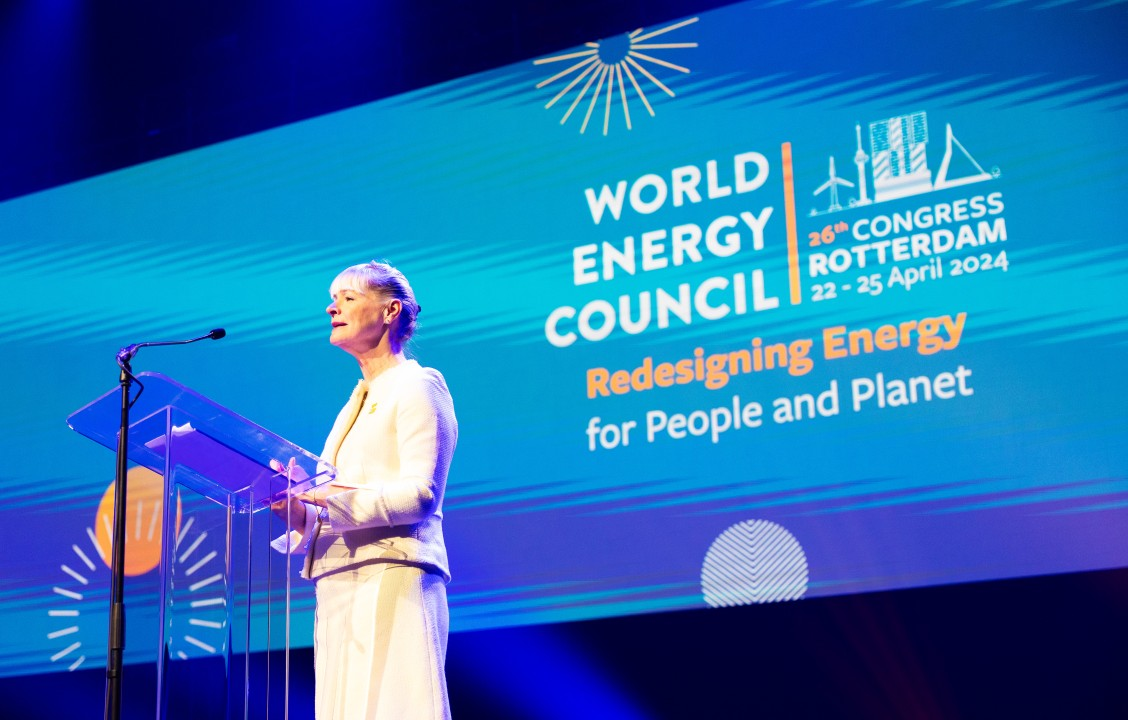
Held in Rotterdam in April 2024, the 26th World Energy Congress convened global energy leaders to examine how energy systems can be redesigned to balance security, decarbonisation, and social priorities amid accelerating global change.
The 26th World Energy Congress took place from 22–25 April 2024 in Rotterdam, the Netherlands, bringing together policymakers, industry leaders, investors, and experts from across the global energy sector. Organised by the World Energy Council and co-hosted with the Netherlands Ministry of Economic Affairs and Climate Policy, the Congress carried particular significance as it marked 100 years since the Council’s founding.
Held under the theme “Redesigning Energy for People and Planet,” the centenary edition focused on how energy systems can adapt to intersecting pressures—from climate commitments and technological change to geopolitical uncertainty and demand growth. Across the multi-day programme and exhibition, sessions examined pathways for accelerating clean energy deployment while maintaining system reliability and affordability.
Environmental considerations featured prominently through discussions on scaling low-carbon technologies, mobilising finance, and modernising infrastructure to support energy transitions at pace. Rather than treating redesign as a purely technical exercise, the Congress framed it as a system-wide challenge that links innovation, policy, and implementation across regions with differing starting points and constraints.
Social dimensions formed a parallel strand throughout the programme. Speakers addressed how energy transitions affect households, workforces, and communities, with emphasis on affordability, access, and workforce readiness. The diversity of participants—from governments and utilities to civil society and multilateral organisations—reflected broad recognition that durable transitions require inclusive approaches alongside technological progress.
Governance and collaboration were reinforced through the Congress’s co-hosting structure and international participation. Discussions highlighted the importance of policy coordination, cross-border cooperation, and stable regulatory environments in supporting long-term investment and accountable delivery.
As the World Energy Congress enters its second century, the 2024 edition reaffirmed its role as a convening platform for translating dialogue into coordinated action—supporting energy systems that are resilient, inclusive, and capable of meeting global demands in a period of rapid change.