

Insights from the APSAE Summit 2026 panel on monetising data, partnerships and non-dues income
Ask an association leader about non-dues revenue and the conversation often begins with the same question: Where do we find new sources of income?
A panel at the APSAE Summit 2026 challenged that thinking entirely.
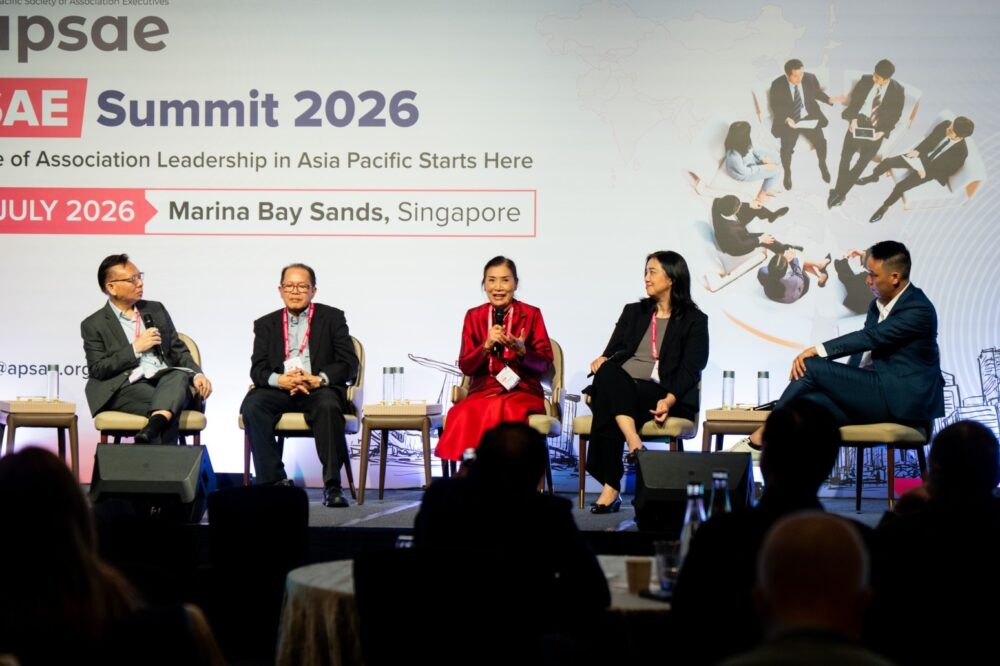
Moderated by Associations Commons Co-Founder and CEO Ooi Peng Ee, Beyond Dues – Monetising Data, Partnerships & Non-Due Revenues brought together four association leaders from very different sectors. While each organisation shared its own experience, a common thread quickly emerged: associations do not have a revenue problem nearly as much as they have a value creation problem. When organisations consistently create meaningful value, sustainable revenue tends to follow.
The discussion opened with Dr. Supaporn Chuangshid, Executive Secretary of the Association of Universities of Asia and the Pacific (AUAP), who argued that financial sustainability begins with member relevance. Conferences, leadership development, international collaborations and strategic partnerships all generate opportunities for revenue, but only because they first create value for members. Underpinning every successful partnership, she noted, are trust, transparency and good governance—qualities that enable organisations to build relationships that endure beyond individual projects.
That philosophy was reinforced from a different perspective by Jessie Li, Regional Director for East and Southeast Asia at the Society of Actuaries (SOA). In many markets, SOA members also belong to their national actuarial associations. Rather than competing for the same members, the SOA has deliberately focused on complementing local associations, working together to strengthen the profession and deliver greater value to shared members. Her contribution illustrated that sustainable growth can come not only from developing new products, but from expanding the overall value created through collaboration.
For the Asian Bankers Association, collaboration has evolved into a practical business model. Deputy Secretary Amador Honrado explained how ABA generates non-dues income through revenue-sharing arrangements with conference hosts, jointly organised professional development programmes with knowledge partners, and carefully managed advertising opportunities within its publications. These initiatives succeed because every partner contributes distinct capabilities while sharing both the risks and rewards. Equally important is protecting member trust by ensuring commercial activities remain relevant to the association’s mission.
Perhaps the session’s most commercially focused perspective came from Bryan Tay, General Manager of the Singapore FinTech Association (SFA). He observed that community may be an association’s greatest asset, but community alone does not sustain an organisation financially. SFA therefore applies commercial discipline to everything it does—building strategic partnerships, developing an active sales pipeline and designing initiatives that simultaneously serve the wider ecosystem, deliver exclusive member benefits and create proprietary organisational assets.
His example of SFA’s fintech internship platform demonstrated how a single initiative can operate on multiple levels: providing open access to the ecosystem, offering premium management tools for members and generating anonymised talent-market insights that become valuable intellectual property. Rather than treating revenue generation as separate from the association’s mission, SFA embeds commercial sustainability into the way programmes are designed from the outset.
Although the panellists represented banking, financial services, higher education and technology, their conclusions were remarkably consistent. Partnerships are replacing transactional relationships. Collaboration is increasingly outperforming competition. Data is becoming a strategic asset when managed responsibly. Most importantly, commercial sustainability should reinforce an association’s purpose—not dilute it.
For association leaders facing rising costs and increasing member expectations, perhaps the session’s most valuable insight was also its simplest.
The first question should never be, “How do we generate more non-dues revenue?”
Instead, ask, “What value can only our association create?”
Organisations that answer that question well are far more likely to build the partnerships, trust, relevance and commercial opportunities that sustain them over the long term.
As the discussion concluded, one message stood above all others: revenue is not the destination. It is the outcome of creating something that members, partners and society genuinely value.
Editor’s note: “Associations Commons was the media partner of APSAE Summit 2026. This article is part of our continuing series exploring ideas that will shape the future of association leadership.”