
IHPBA’s Singapore congress combines specialist education with a defined liver cancer equity agenda. For association leaders, its significance lies in how scientific authority can be organised into action after delegates leave.
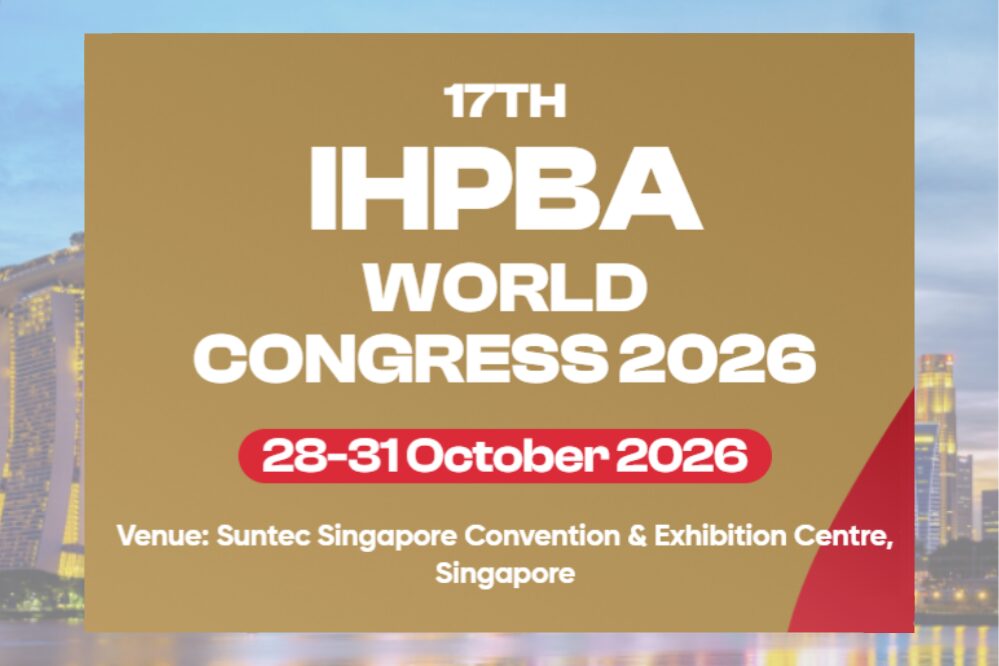
Singapore — The 17th World Congress of the International Hepato-Pancreato Biliary Association, taking place on 28–31 October 2026 at Suntec Singapore Convention & Exhibition Centre, offers an unusually concrete proposition for association leaders: use a specialist congress to organise a continuing response to unequal access to care.
Congress President Shridhar Iyer also leads its legacy project. The initiative addresses disparities in hepatocellular carcinoma, or HCC, outcomes across Asia-Pacific and lower-income settings. Its ambition connects the association’s professional expertise with a public-interest problem that cannot be resolved through scientific presentations alone.
Authority Across Generations and Settings
The speaker line-up includes Laurence Chiche, Keith Lillemoe and Sung-Gyu Lee in the Living Legends series, addressing a surgical career, bile duct injuries and living donor liver transplantation. Their lectures are scheduled across 29–31 October.
Other announced contributors bring contrasting practice environments into view. Jen Jen Yeh will discuss pancreatic cancer molecular subtypes; Tin Tin Mar will address bile duct disorders in resource-constrained settings; Mariano Gimenez will examine artificial intelligence and automation in computer-assisted surgery. This breadth is relevant to a global membership whose institutions have very different resources.
For an association, faculty selection communicates whose experience counts. Combining advanced technology with constrained clinical settings can help prevent a world congress from presenting innovation solely through the capabilities of its best-funded members. The management challenge is to carry that balance into participation, discussion and subsequent education.
A Programme with Several Routes into Membership
The four-day structure begins with pre-congress activities on 28 October. Published formats include postgraduate courses, allied health education, technical training and an Early Career Group research retreat. The main scientific programme combines plenary lectures, symposia, debates, research presentations, video content and sessions with partner societies.
Small-group Meet the Expert sessions are limited to 20 participants. The early-career retreat adds discussion of research collaboration, knowledge exchange and AI in surgical careers. These formats create different routes to engagement: hearing an established authority, testing a practical question and finding collaborators at a similar professional stage.
That design has strategic value beyond registration revenue. An early-career member who leaves with a research relationship has a reason to remain involved between congresses. A partner society contributing substantive content also has a stronger basis for cooperation than an organisation receiving only an invitation or logo placement.
The distinctive proposition is this combination of technical depth, intergenerational exchange and an explicit equity project. It gives leadership a framework for connecting the congress to the association’s continuing work, rather than evaluating each programme component in isolation.
From Declaration to Accountable Delivery
IHPBA’s published legacy plans include an APAC HCC Equity Roadmap, an Equity Forum, a heatmap and the ACCESS HCC framework. A Singapore Declaration on HCC Equity and an ethical living donor transplantation white paper are also planned. A dedicated legacy session is intended to move discussion towards action.
The initiative builds on the association’s Cape Town 2024 legacy work and has received an Incredible Impacts seed fund grant from ICCA and BestCities. These are documented foundations and commitments; they are not evidence that the proposed Singapore outputs have already improved patient outcomes.
For association boards, the next question is ownership. A declaration needs an accountable group, a work schedule and a route for local professional bodies to participate. An equity map needs agreed definitions, credible information and a process for updates. Without those arrangements, a useful congress output can become a document that attracts attention briefly and then loses institutional support.
Evaluation should therefore distinguish stages. Publishing a roadmap is an output. Securing participating institutions and adopting agreed reporting methods would demonstrate uptake. Changes in timely diagnosis or access to treatment would require longer observation and evidence connecting those changes to the work undertaken.
An appropriate management response would be to establish a public progress cycle after the congress, with responsibilities and realistic milestones. That would allow members to see how their expertise contributes and help future hosts build on an existing programme. A board could also separate the resources needed to convene experts from those required to maintain regional work. Funding an initial discussion is a different obligation from supporting data collection or implementation. Making those costs visible would help members and partners understand what further participation is being requested, and why.
Singapore’s strongest potential legacy is consequently organisational as well as clinical: a repeatable way for a global association to turn its congress into sustained regional collaboration.