


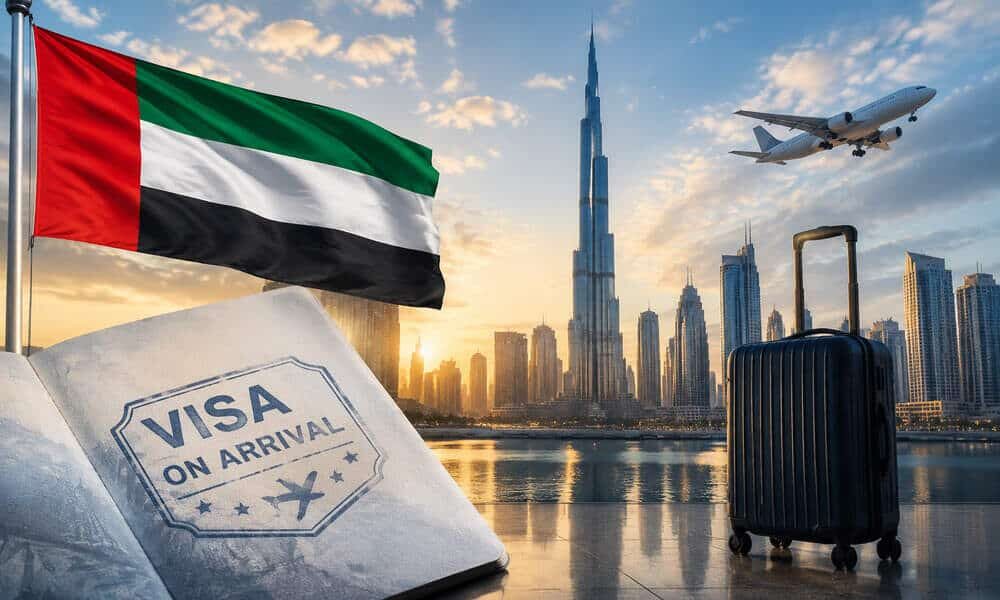
ABU DHABI — The United Arab Emirates has significantly expanded its visa-on-arrival programme, extending eligibility to travellers from ten countries across Asia and Africa as part of its broader strategy to improve international connectivity and strengthen its position as a global hub for business, tourism and investment.
The latest expansion adds Kenya and South Africa to the programme, following the earlier inclusion of Indonesia, Vietnam, Thailand and the Philippines. Eligible travellers holding ordinary passports, together with accompanying family members, may obtain either a 14-day or 60-day visa on arrival, provided they hold a valid residence permit issued by the United States, a European Union member state, the United Kingdom, Singapore, Japan, South Korea, Australia, New Zealand or Canada.
Under the revised framework, the 14-day visa may be extended once, while the 60-day visa is issued for a single stay and cannot be extended. The visa-on-arrival programme forms part of the UAE’s wider efforts to simplify travel procedures and improve accessibility for international visitors.
In announcing the expansion, the UAE Ministry of Foreign Affairs said the initiative reflects the country’s commitment to strengthening bilateral relations, facilitating the movement of travellers and reinforcing the UAE’s position as a leading destination for business, investment, entrepreneurship and talent. The Federal Authority for Identity, Citizenship, Customs and Ports Security (ICP) added that the changes align with international best practices in travel, tourism and mobility while expanding the number of travellers eligible for simplified entry procedures.
The move is expected to benefit business travel across Asia-Pacific, particularly as the region accounts for a growing share of international meetings, incentives, conferences and exhibitions. Easier entry requirements can reduce administrative barriers for delegates, exhibitors and corporate travellers attending events in the UAE, which continues to strengthen its position as one of the Middle East’s leading business events destinations.
As competition intensifies among global MICE hubs, visa facilitation is increasingly becoming part of destination strategy. Alongside investment in convention infrastructure, aviation connectivity and business-friendly policies, streamlined entry procedures are emerging as an important factor influencing where international meetings and events are held.