

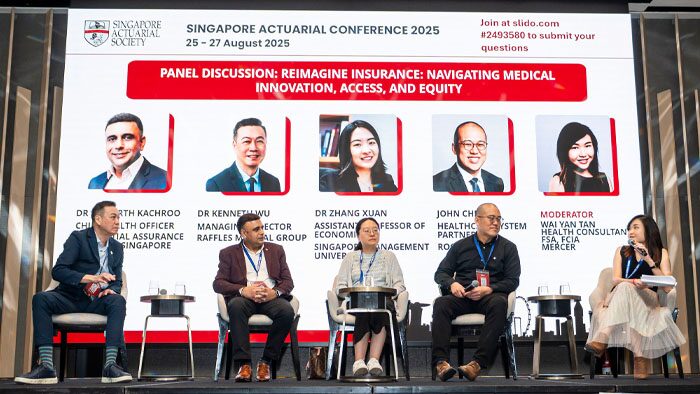
The Singapore Actuarial Conference 2025 (SAC 2025), organised by the Singapore Actuarial Society, was held on 25 August 2025 at the Raffles City Convention Centre in Singapore. As the society’s flagship annual event, the conference marked approximately its 17th edition and brought together over 400 delegates from Singapore, Australia, Hong Kong, the United Kingdom, and other Asia-Pacific markets.
The conference convened actuarial professionals, regulators, insurance executives, pension specialists, academics, and fintech providers, with participation from representatives of the Monetary Authority of Singapore (MAS) and international actuarial experts. Mr Tan Kian Chew, President of the Singapore Actuarial Society, was among the key figures contributing to the programme.
The event focused on the role of actuarial science in addressing emerging risks across financial systems, with discussions centred on climate risk, artificial intelligence, retirement systems, and healthcare financing. Sessions examined how actuarial methodologies are being applied to support risk management, regulatory alignment, and long-term sustainability across insurance, pensions, and healthcare sectors.
Dr Patrick Lee led a session on climate risk modelling and insurance pricing, where he examined how climate scenarios can be integrated into actuarial valuation and capital frameworks. The session also explored approaches to incorporating carbon transition risks into solvency assessments and long-term liability modelling. Complementing this, specialists from global insurers discussed catastrophe risk pricing models and climate stress testing techniques used in underwriting and capital allocation.
Artificial intelligence in actuarial science was addressed by Ms Angela Tan, who demonstrated the use of machine learning in predictive risk modelling. Her session focused on how data-driven tools are being applied to enhance forecasting accuracy and support decision-making in increasingly complex risk environments.
Social and demographic challenges were examined through sessions on retirement and healthcare systems. Mr David Lim presented on retirement adequacy in ageing societies, outlining multi-pillar pension frameworks that combine public, occupational, and private savings mechanisms. Dr Melissa Wong addressed healthcare financing sustainability, introducing models based on cost-sharing and risk pooling to improve long-term affordability and system resilience.
Governance and regulatory considerations were also discussed throughout the conference. Representatives from the Monetary Authority of Singapore outlined supervisory expectations related to solvency requirements and enterprise risk management. Mr Tan Kian Chew emphasised the importance of actuarial ethics, professional standards, and transparent risk reporting in strengthening accountability across financial institutions.
The Singapore Actuarial Conference 2025 reflects the evolving role of actuarial science in addressing complex financial and societal risks. As economies across the region face challenges related to climate change, ageing populations, and healthcare sustainability, the conference provided a platform for industry and regulatory stakeholders to exchange perspectives and examine approaches to long-term risk management.